By Yingchu Shen
Desplácese hacia abajo para ver la publicación en español.
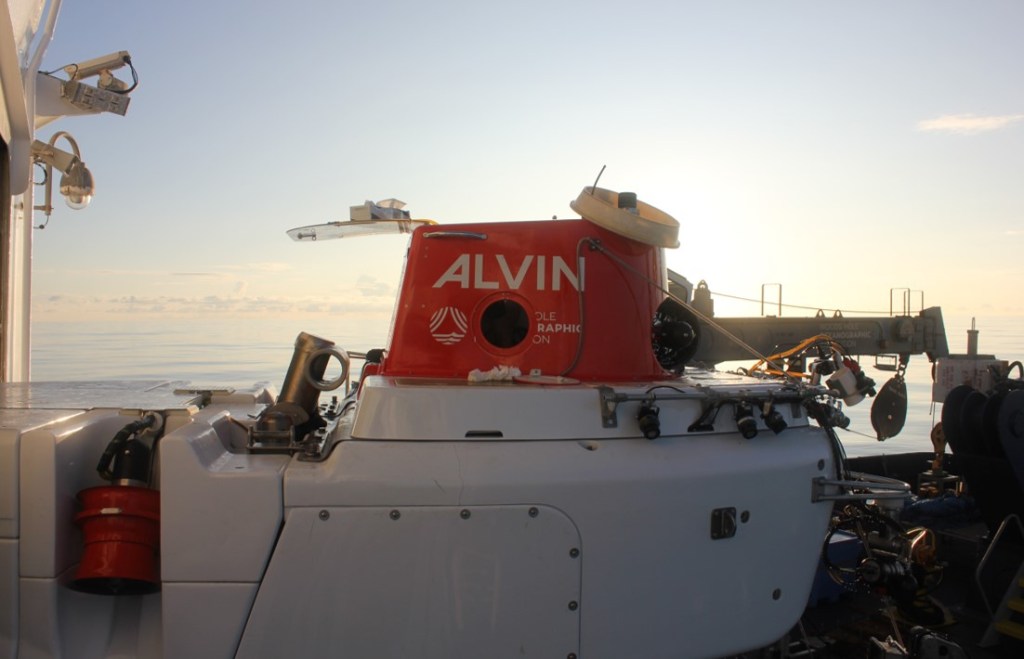
As a 3rd-year PhD student based at the University of Bristol, I participate the cruise Galápagos Deep 2023 as a member of the paleoceanography team, in aim of helping with collecting deep-sea coral, seawater and sediment samples, and broadening horizon in at-sea experience and skills, as this is my first ever scientific cruise. The R/V Atlantis is the research vessel, and the main geological and biological sampling will be achieved through using the submarine Alvin.
I still remember the excitement each of my senior group members expressed when it was announced that we would be on the R/V Atlantis and in Alvin back to early 2022. In comparison, at that time I literally had no idea of what was about to happen. More thoughts clouding my mind were the general questions, like “if the food would be tasty on the ship – will we have sufficient fresh fruits and vegetables?”, “will I get sea sick or I am one of the lucky ones that can escape?”… I have only heard about some common deep-sea sampling methods, for instance, ROV (remotely operated vehicle), dredge and trawls. But, what about Alvin – how will this work – to be a bit more specific?
Things gradually got real and clear this March – we got on board, gradually set up labs and equipment. We successfully sampled CTD (conductivity, temperature, and depth) for seawater, and multi-core for sediments. Each of the cruise science participants received an appropriate 45-min Alvin training session for basic functions and safety awareness by pilot Nick – the PIs have made thoughtful arrangements that each participate get at least one chance to participate Alvin dive, and experience how’s it like to “sink” into the bottom ocean, and observe the mysterious deep sea world. I get to learn a bit of background information about Alvin. Alvin is one of the world’s first and most well-known deep-ocean submersibles, and has been serving for scientific exploration over the past fifty years. It can accommodate two scientists for up to 6,500m and last up to ten hours, and has brought enormous key findings for ocean sciences.
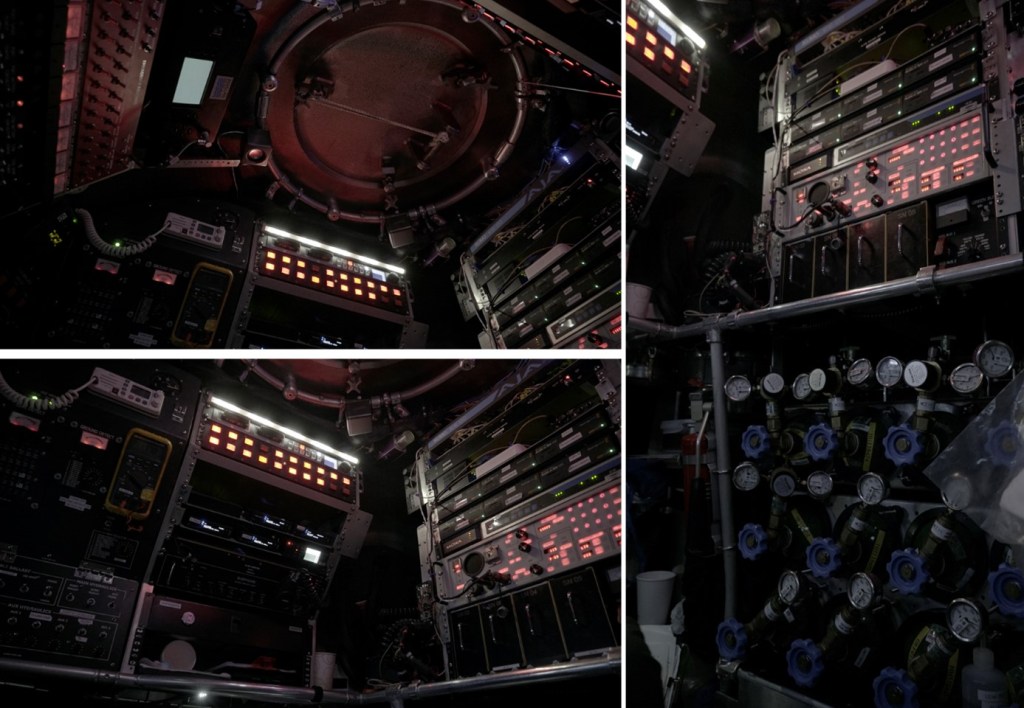
Finally, Darin and I have been assigned as observers for the dive, and Bruce is our pilot to help achieve imagery documentation and sampling goals. This dive targets for the base of the Floreana Island, in aim of determining the emplacement mode of the largest exposed, sheet-like lava flows that formed the deepest foundation of the Galápagos Platform. The anticipated maximum dive depth will be around 3,400m, which makes it the deepest among all of the Galápagos Deep 2023 dives (which is quite cool :-). Although we do not anticipate greeting cold-water stony corals, as the comprehensive environment in the east Equatorial Pacific ocean at equivalent depth is harsh for them to survive or get preserved, if we observe common and representative marine creatures, opportunist sampling of these biological specimens will also be attempted.
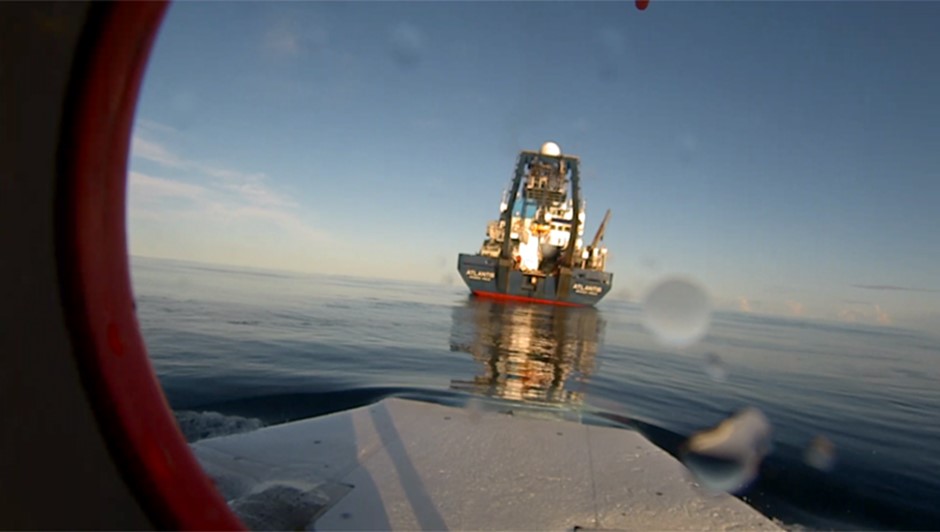
Now it’s time to be in the deep ocean. After Alvin launched, we gradually sunk into the ocean, and headed to the first scheduled waypoint. The usual speed for Alvin to cruise is about 0.8 km per hour (full speed 3.4 km per hour), and it took us about one and half an hour to reach the bottom of the ocean. We received greetings from a fish shoal at the beginning, and the views outside observation windows turned from clear light blue into the dark, as both natural light and temperature decrease with ocean deepening.

After we arrived at the first and second waypoints, to begin with, things might be a bit different than we would have imagined. Rather than large-scale pillow lavas, the seafloor was relatively quiet and peaceful, dominated by continuous muddy sediments. Until after about one hour of searching and spotting, volcanic rocks suddenly appeared in our eyesight – the pillow lava rocks were exactly what we were looking for today’s dive, as they record seafloor volcanic activities of various magnitudes from different times and spaces in the geological past.

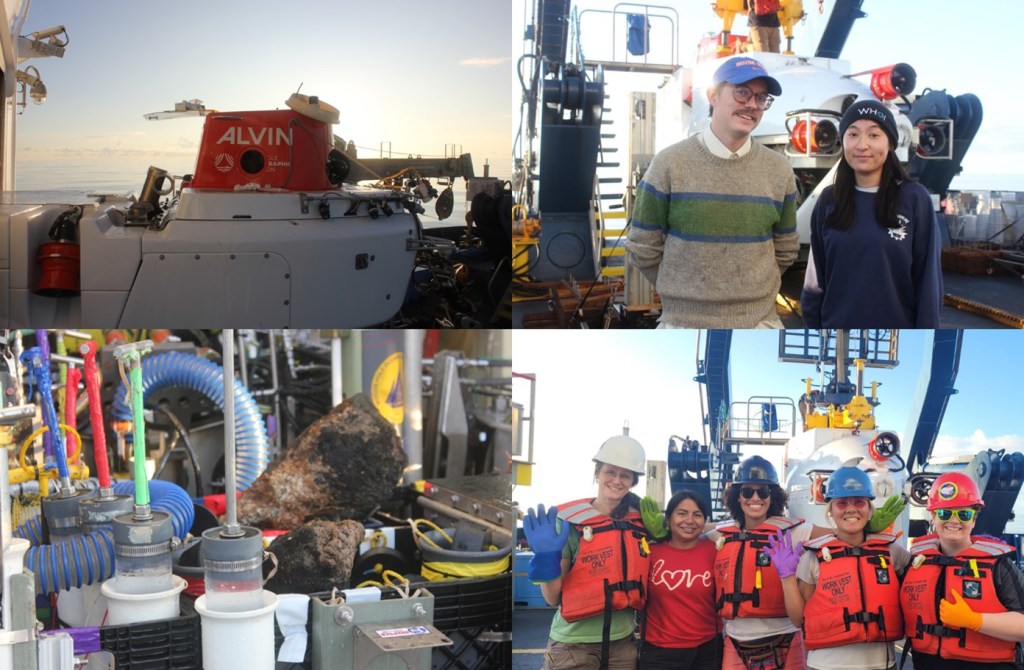
Things turned to become interesting and exciting (!), and we started to collect geological and biological samples. Although full of challenges when collecting rock samples from the steep pillow lava wall at the beginning – it was hard for Alvin to settle down, after several attempts, several rock samples were successfully collected by arm grabbing. Two of them were giant in size, one confirmed to be 22kg during the post-dive rock sample possessing. Meanwhile, different than most of us would have imagined, the ocean over 3,000m is actually not silent as death, but vibrant and vivid. Among them, a specific species of sea cucumber (Psychopaths) that look like blue/purple dinosaurs, and bamboo coral that are useful for trace elemental and isotopic paleoceanography research are of particular interest – see photos below for selected biological sampling.
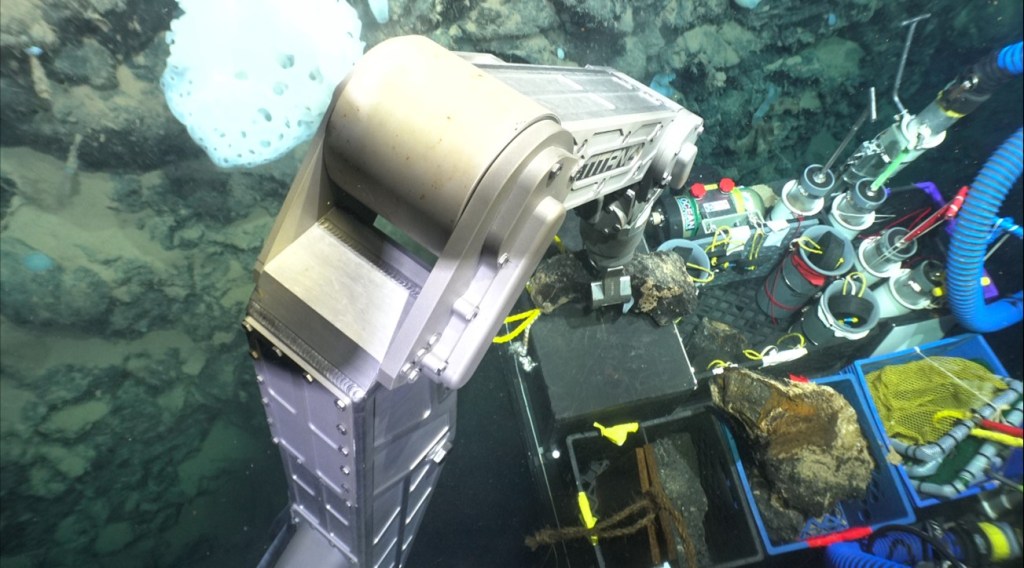
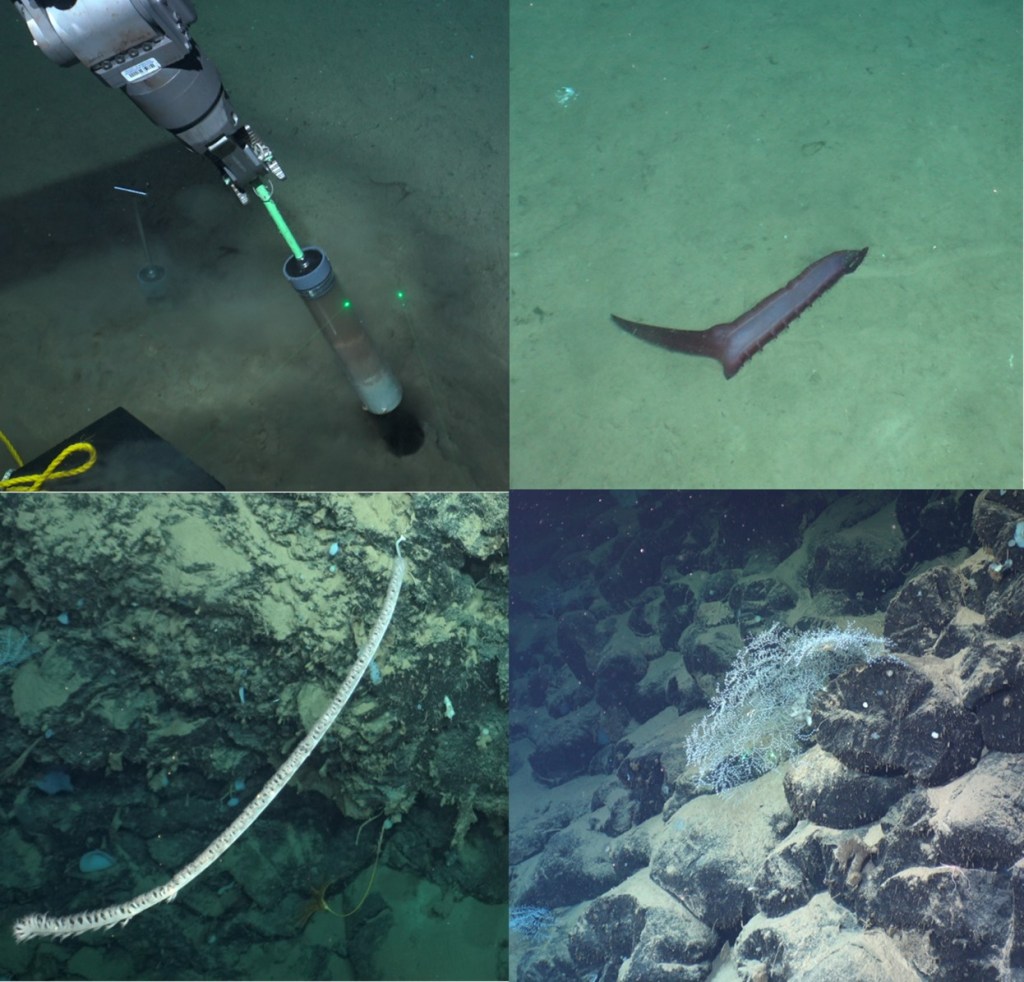
After about 5.5-hour deep sea exploration over 3,000m depth, we were on the way to return back to the surface. 6 rocks, 4 push cores, 1 Niskin seawater bottle and 4 biological samples have been collected, so we felt quite relieved, and patiently waited for Alvin to get recovered (Bruce and Darin even started to discuss Infinity from divergent angles – philosophy, maths…!).

Under the sunset, Alvin was back on deck. The cruise members have been fully prepared with cold water buckets to welcome the geological and biological samples, and now it’s time to unpack and process them!
Overall, it’s an unforgettable experience for me to have the opportunity of being in Alvin, and exploring the deep ocean over 3,000m. Through the group effort of science, Alvin and crew team, we have the unique chance to carry out “in-person” interviews and conversations with the deep-sea world. Look forward to seeing what stories the samples will tell us about the past and present east Equatorial Pacific!
Abajo en lo profundo: Experiencia de estar en el submarino Alvin
Como estudiante de doctorado de tercer año con sede en la Universidad de Bristol, participo en el crucero Galápagos Deep 2023 como miembro del equipo de paleoceanografía, con el objetivo de ayudar a recolectar corales de aguas profundas, muestras de agua de mar y sedimentos, y ampliar el horizonte en al menos -Experiencia y habilidades en el mar, ya que este es mi primer crucero científico. El R/V Atlantis es el buque de investigación, y el principal muestreo geológico y biológico se logrará mediante el uso del submarino Alvin.
Todavía recuerdo la emoción que expresó cada uno de los miembros senior de mi grupo cuando se anunció que estaríamos en el R/V Atlantis y en Alvin a principios de 2022. En comparación, en ese momento literalmente no tenía idea de lo que estaba a punto de ocurrir. suceder. Más pensamientos que nublaron mi mente fueron las preguntas generales, como “si la comida fuera sabrosa en el barco, ¿tendremos suficientes frutas y verduras frescas?”, “¿Me marearé en el mar o seré uno de los afortunados que puede escapar?” … Solo he oído hablar de algunos métodos comunes de muestreo en aguas profundas, por ejemplo, ROV (vehículo operado por control remoto), dragas y redes de arrastre. Pero, ¿qué pasa con Alvin, cómo funcionará esto, para ser un poco más específico?
Las cosas se volvieron reales y claras gradualmente en marzo: subimos a bordo, instalamos laboratorios y equipos gradualmente. Tomamos muestras con éxito de CTD (conductividad, temperatura y profundidad) para agua de mar y multinúcleo para sedimentos. Cada uno de los participantes de ciencia de cruceros recibió una sesión de capacitación Alvin apropiada de 45 minutos para funciones básicas y conciencia de seguridad por parte del piloto Nick: los PI han hecho arreglos cuidadosos para que cada participante tenga al menos una oportunidad de participar en el buceo Alvin y experimente cómo es. “hundirse” en el fondo del océano y observar el misterioso mundo de las profundidades marinas. Puedo aprender un poco de información de fondo de Alvin. Alvin es uno de los primeros y más conocidos sumergibles de aguas profundas del mundo, y ha estado sirviendo para la exploración científica durante los últimos cincuenta años. Puede acomodar a dos científicos hasta 6.500 m y durar hasta diez horas, y ha aportado enormes hallazgos clave para las ciencias oceánicas.
Finalmente, Darin y yo fuimos asignados como observadores para la inmersión, y Bruce es nuestro piloto para ayudar a lograr la documentación de imágenes y los objetivos de muestreo. Esta inmersión tiene como objetivo la base de la isla Floreana, con el objetivo de determinar el modo de emplazamiento de los flujos de lava en forma de lámina expuestos más grandes que formaron la base más profunda de la Plataforma de Galápagos. La profundidad de inmersión máxima anticipada será de alrededor de 3400 m, lo que la convierte en la más profunda entre todas las inmersiones Galápagos Deep 2023 (que es bastante genial :-). Aunque no anticipamos saludar a los corales pétreos de agua fría, ya que el entorno integral en el océano Pacífico ecuatorial oriental a una profundidad equivalente es difícil para que sobrevivan o se conserven, si observamos criaturas marinas comunes y representativas, muestreo oportunista de estos especímenes biológicos también se intentará.
Ahora es el momento de estar en las profundidades del océano. Después del lanzamiento de Alvin, nos hundimos gradualmente en el océano y nos dirigimos al primer punto de ruta programado. La velocidad habitual de crucero de Alvin es de aproximadamente 0,8 km por hora (velocidad máxima de 3,4 km por hora), y tardamos aproximadamente una hora y media en llegar al fondo del océano. Recibimos saludos de un banco de peces al principio, y las vistas fuera de las ventanas de observación cambiaron de azul claro claro a oscuro), ya que tanto la luz natural como la temperatura disminuyen con la profundidad del océano.
Después de llegar al primer y segundo punto de referencia, para empezar, las cosas podrían ser un poco diferentes de lo que hubiéramos imaginado. En lugar de lavas almohadilladas a gran escala, el lecho marino era relativamente tranquilo y pacífico, dominado por continuos sedimentos fangosos. Hasta que, después de aproximadamente una hora de buscar y detectar, de repente aparecieron rocas volcánicas a nuestra vista: las rocas de lava almohadillada eran exactamente lo que buscábamos en la inmersión de hoy, ya que registran actividades volcánicas del lecho marino de diversas magnitudes en diferentes momentos y espacios del pasado geológico.
Las cosas se volvieron interesantes y emocionantes (!), y comenzamos a recolectar muestras geológicas y biológicas. Aunque al principio estuvo lleno de desafíos al recolectar muestras de roca de la empinada pared de lava almohadillada, fue difícil para Alvin establecerse, después de varios intentos, varias muestras de roca fueron recolectadas con éxito tomándolas del brazo. Dos de ellos eran de tamaño gigante, uno confirmó que pesaba 22 kg durante la toma de muestras de roca posterior a la inmersión. Mientras tanto, a diferencia de lo que la mayoría de nosotros hubiéramos imaginado, el océano a más de 3000 m en realidad no es tan silencioso como la muerte, sino vibrante y vívido. Entre ellos, una especie específica de pepino de mar (psicópatas) que se parece a los dinosaurios azules/púrpuras, y el coral de bambú que son útiles para la investigación de paleoceanografía isotópica y de elementos traza son de particular interés; vea las fotos a continuación para obtener muestras biológicas seleccionadas.
Después de una exploración de aguas profundas de aproximadamente 5,5 horas a más de 3000 m de profundidad, estábamos en camino de regresar a la superficie. Se recolectaron 6 rocas, 4 núcleos de empuje, 1 botella de agua de mar Niskin y 4 muestras biológicas, por lo que nos sentimos bastante aliviados y esperamos pacientemente a que Alvin se recuperara (Bruce y Darin incluso comenzaron a hablar sobre Infinity desde ángulos divergentes: filosofía, matemáticas… !).
Bajo la puesta de sol, Alvin estaba de vuelta en cubierta. Los miembros del crucero han sido completamente preparados con baldes de agua fría para recibir las muestras geológicas y biológicas, ¡y ahora es el momento de desempacarlas y procesarlas!
En general, es una experiencia inolvidable para mí tener la oportunidad de estar en Alvin y explorar las profundidades del océano a más de 3000 m. A través del esfuerzo grupal de la ciencia, Alvin y el equipo de la tripulación, tenemos la oportunidad única de llevar a cabo entrevistas y conversaciones “en persona” con el mundo de las profundidades marinas. ¡Esperemos ver qué historias nos contarán las muestras sobre el pasado y el presente del Pacífico Ecuatorial Oriental!
 Galápagos Deep 2023 Expedition
Leave a comment