
By Samuel Mitchell
Desplácese hacia abajo para ver la publicación en español
Sometimes labwork onboard a research ship is incredibly clean – use of chemicals, sterilizing agents – but sometimes it has no choice but to get messy… sampling marine sediments is one of those times.
One of the primary objectives of our expedition is to characterize the climate history (paleoclimate and paleoceanography) of the Galápagos platform using live corals, fossil corals, but also the sediments (sand, silt and mud) that lie on the seafloor. Marine sediments can also contain foraminifera (shortened as forams), which are microscopic single-celled carbonate organisms that lock in the surrounding water chemistry and marine environment at the time they grow.
We can use these forams to build a picture of changing marine environments over time by analyzing the oxygen and carbon isotopes, and their age. But one problem… they’re on the seafloor and we’re up here on the ship, and submersible cameras can’t see through mud to older layers, so we have to bring them up to us.
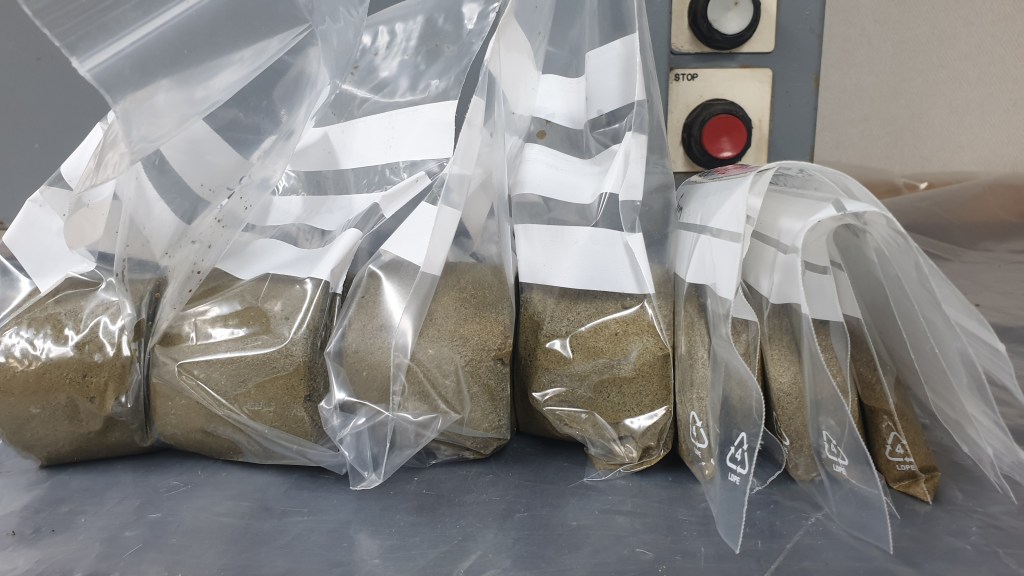
We’re sampling these marine sediments through two methods: 1) “push cores” using the Alvin submersible, and 2) “multicoring” off the side of the ship. On each Alvin dive we put four push cores on the front of the Alvin basket. As there are multiple operations and types of samples to collect using the submersible, there is only space for four push cores on our basket.
Here is the recipe for a perfect pushcore operation to make all your scientists happy:
- Send your submersible down to the seafloor and find some fine-grained marine sediments, nice and flat, with no obvious rocky underlayer.
- Use the Alvin manipulator (arms) to grab one of the 35sm push cores from the front basket and push the core into the sediment. Do this twice in once location, so one can preserved for later, and one can be sliced up on the ship.
- Carefully retrieve the pushcores from the sediment and place them back into their holder ensuring they are pushed down to seal in those nice sediments.

4. After the dive and once the submersible is back on the deck, remove the pushcores from the basket and bring them into the lab to process.
5. Very carefully (using multiple scientists to help) remove the core from its holder and seal the bottom so you don’t lose the sediment. Preserve one for more detailed analysis after the cruise and slice other up to make notes on the layers and grains inside. All of these cores will need to be carefully described layer by layer – colour, grain size, grain type, sedimentary features and more!
6. Put your preserved and slice cores into cold room at 4’C until the end of cruise. Done!
The processing of slicing the cores can of course get very messy! There’s no knowing what the marine sediments will be like until they are on board. Ideally we’d like nice, well-layered muds that have enough water to bind them, making them easy and quick to slice. But sometimes it’s a tube of unconsolidated sand, and sometimes it’s a water muddy mess. So be prepared for a messy lab… but that’s why the sediment team were placed in the “wet lab”. The moment of transferring the pushcore onto the “extruder” is the most nail-biting part, a small slip might lose you the whole core, but we’re doing well so far!
We’ve had one coring operation yes, but what about a second coring operation? Let’s talk about the multicorer!

The multicore is an on-deck operation that requires a full team. While the pushcores are limited to where Alvin dives, the multicore can be done in any location below the ship as long as we are confident there is sediment to sample. How do we do this? We use the bathymetry (maps of seafloor depth and topography), backscatter (how rough or smooth the seafloor is) and an echosounder (to see if sound penetrates through rock or something softer). Ideally we look for a spot that is flat, smooth and soft from acoustic returns. Our final check is a camera attached to the multicorer to confirm if the site we are about to core has sediment, but this isn’t known until we reach the seafloor!
The multicore on Atlantis is a bespoke rig, made up of four, much larger (65cm) and wider cores to acquire a deeper record of sediment. It has the down-pointing camera, telemetry, a water sampling bottle and also a CTD attached – more about this in another post. But essentially it is a multi-data platform. It is deployed over the side of the ship using a winch and tethered line.

The multicore operation can take a long time (3 or 4 hours) if the site is very deep, but if it’s successful, it is worth it. Just 30cm of seafloor sediment could potentially sample several thousands of years of ocean environment history, which is essential for matching with the fossil corals we are also interested in!
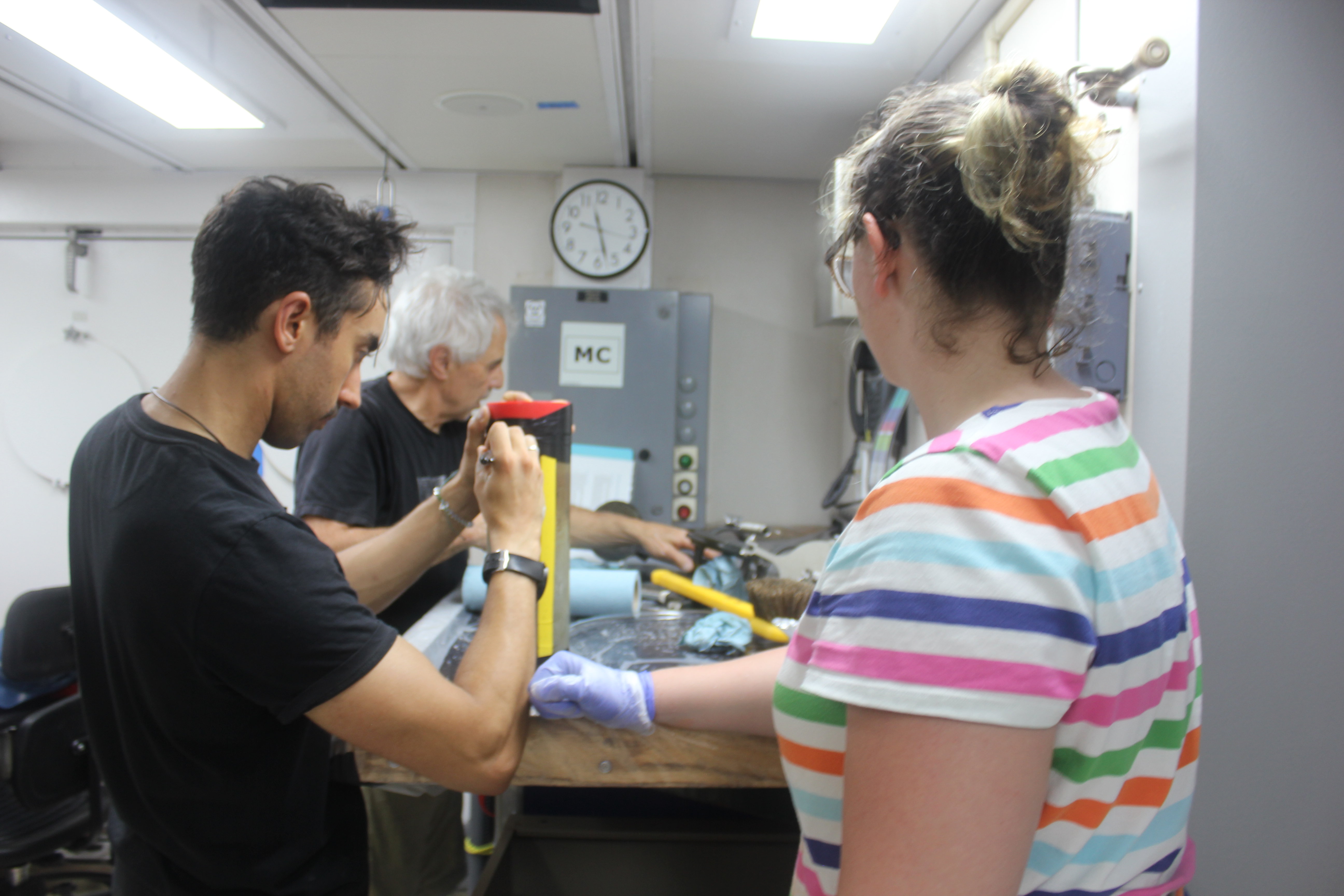
Once back on the ship, the multicore undergoes the same spa routine that the pushcores go through, but they’re heavier (more sediment and water), and require more hands to effectively sample. Again, the transfer onto the slice extruder is a nail-biting operation, but all have been successful so far! These cores also get photographed, described, and then either sliced or preserved. By sampling sediments across and around the Galápagos platform we capture a full history of these waters through space, time and the influence of different ocean currents, which is critical to our mission.
It’s certainly a messy operation, but everyone has been willing to jump in with an extra hand to save some of the more watery cores. Personally, I love dealing with sedimentary records… although I’m not sure if the nicknames of Multicore Man and Sediment Boy should keep beyond the expedition. Until next time… go Team Sediment!
L: Sam, Dan and Ana preserving one of the multicores. R: Maoyu using a 1-cm spacer to slice up a multicore on the larger extruder.

Procesamiento de muestras: Sedimentos y extracción de testigos del fondo marino profundo
Por Samuel Mitchell
A veces, el trabajo de laboratorio a bordo de un barco de investigación es increíblemente limpio (uso de productos químicos, agentes esterilizantes), pero a veces no tiene más remedio que ensuciarse… el muestreo de sedimentos marinos es una de esas ocasiones.
Uno de los principales objetivos de nuestra expedición es caracterizar la historia del clima (paleoclima y paleoceanografía) de la plataforma de Galápagos utilizando corales vivos, corales fósiles, pero también los sedimentos (arena, limo y lodo) que se encuentran en el fondo marino. Los sedimentos marinos también pueden contener foraminíferos (abreviados como foraminíferos), que son organismos microscópicos de carbonato unicelulares que bloquean la química del agua circundante y el entorno marino en el momento en que crecen.
Podemos usar estos foraminíferos para construir una imagen de los entornos marinos cambiantes a lo largo del tiempo mediante el análisis de los isótopos de oxígeno y carbono, y su edad. Pero hay un problema… están en el lecho marino y nosotros estamos aquí arriba en el barco, y las cámaras sumergibles no pueden ver a través del lodo las capas más viejas, así que tenemos que traerlas hasta nosotros.
Estamos muestreando estos sedimentos marinos a través de dos métodos: 1) “núcleos de empuje” utilizando el sumergible Alvin , y 2) “multicores” desde el costado del barco. En cada inmersión de Alvin , colocamos cuatro núcleos de empuje en la parte delantera de la canasta de Alvin . Como hay múltiples operaciones y tipos de muestras para recolectar usando el sumergible, solo hay espacio para cuatro núcleos de empuje en nuestra canasta.
Aquí está la receta para una operación de empuje perfecta para hacer felices a todos sus científicos:
- Envíe su sumergible al lecho marino y encuentre algunos sedimentos marinos de grano fino, bonitos y planos, sin una capa subyacente rocosa evidente.
- Use el manipulador Alvin (brazos) para agarrar uno de los núcleos de empuje de 35 m2 de la canasta delantera y empujar el núcleo hacia el sedimento. Haga esto dos veces en una ubicación, para que uno pueda conservarse para más tarde y el otro pueda cortarse en el barco.
- Retire con cuidado los núcleos de empuje del sedimento y vuelva a colocarlos en su soporte, asegurándose de que se empujan hacia abajo para sellar esos bonitos sedimentos.
- Después de la inmersión y una vez que el sumergible esté nuevamente en la cubierta, retire los núcleos de empuje de la canasta y llévelos al laboratorio para su procesamiento.
- Con mucho cuidado (con la ayuda de varios científicos), retire el núcleo de su soporte y selle el fondo para que no pierda el sedimento. Conserve uno para un análisis más detallado después del crucero y corte el otro para tomar notas sobre las capas y los granos del interior. ¡Todos estos núcleos deberán describirse cuidadosamente capa por capa: color, tamaño de grano, tipo de grano, características sedimentarias y más!
- Ponga sus núcleos conservados y rebanados en un cuarto frío a 4’C hasta el final del crucero. ¡Hecho!
¡El procesamiento de cortar los núcleos puede, por supuesto, volverse muy complicado! No se sabe cómo serán los sedimentos marinos hasta que estén a bordo. Idealmente, nos gustaría lodos agradables y bien estratificados que tengan suficiente agua para unirlos, haciéndolos fáciles y rápidos de rebanar. Pero a veces es un tubo de arena no consolidada, ya veces es un desastre de agua fangosa. Así que prepárate para un laboratorio desordenado… pero es por eso que el equipo de sedimentos se colocó en el “laboratorio húmedo”. El momento de transferir el núcleo de empuje al “extrusor” es la parte más mordaz, un pequeño desliz puede hacer que pierdas todo el núcleo, ¡pero lo estamos haciendo bien hasta ahora!
Hemos tenido una operación de extracción de muestras, sí, pero ¿qué pasa con una segunda operación de extracción de muestras? ¡Hablemos del multinúcleo!
El multinúcleo es una operación en cubierta que requiere un equipo completo. Si bien los núcleos de empuje se limitan a donde Alvin se sumerge, el multinúcleo se puede realizar en cualquier lugar debajo del barco, siempre que estemos seguros de que hay sedimentos para muestrear. Cómo hacemos esto? Utilizamos la batimetría (mapas de profundidad y topografía del fondo marino), retrodispersión (cuán áspero o suave es el fondo marino) y una ecosonda (para ver si el sonido penetra a través de la roca o algo más blando). Lo ideal es buscar un lugar plano, liso y suave a los retornos acústicos. Nuestra verificación final es una cámara conectada al multicorer para confirmar si el sitio que estamos a punto de extraer tiene sedimentos, ¡pero esto no se sabe hasta que llegamos al fondo marino!
El multinúcleo en Atlantis es una plataforma a medida, compuesta por cuatro núcleos mucho más grandes (65 cm) y más anchos para adquirir un registro más profundo de sedimentos. Tiene la cámara que apunta hacia abajo, telemetría, una botella de muestreo de agua y también un CTD adjunto; más sobre esto en otra publicación. Pero esencialmente es una plataforma de múltiples datos. Se despliega sobre el costado del barco usando un cabrestante y una línea atada.
La operación multinúcleo puede llevar mucho tiempo (3 o 4 horas) si el sitio es muy profundo, pero si tiene éxito, vale la pena. ¡Solo 30 cm de sedimento del fondo marino podrían potencialmente muestrear varios miles de años de historia del medio ambiente oceánico, lo cual es esencial para hacer coincidir los corales fósiles que también nos interesan!
Una vez de vuelta en el barco, el multinúcleo se somete a la misma rutina de spa por la que pasan los núcleos de empuje, pero son más pesados (más sedimentos y agua) y requieren más manos para tomar muestras de manera efectiva. Nuevamente, la transferencia a la extrusora de rebanadas es una operación para morderse las uñas, ¡pero hasta ahora todo ha sido exitoso! Estos núcleos también se fotografían, describen y luego se cortan o conservan. Al tomar muestras de sedimentos a lo largo y alrededor de la plataforma de Galápagos, capturamos una historia completa de estas aguas a través del espacio, el tiempo y la influencia de diferentes corrientes oceánicas, lo cual es fundamental para nuestra misión.
Ciertamente es una operación complicada, pero todos han estado dispuestos a participar con una mano extra para salvar algunos de los núcleos más acuosos. Personalmente, me encanta tratar con registros sedimentarios… aunque no estoy seguro de si los apodos de Multicore Man y Sediment Boy deberían mantenerse más allá de la expedición. Hasta la próxima… ¡adelante Team Sediment!
 Galápagos Deep 2023 Expedition
Leave a comment