By Malu de Carvalho Ferreira
Desplácese hacia abajo para ver la publicación en español.
First day of science, how exciting! It is a beautiful and warm day with calm waters. Old volcanos in the background and rays jumping out of the water. But everyone’s attention is elsewhere: the Alvin! This is the first dive of the expedition and there has been much preparation for it. The labs (and scientists!) are ready to receive the samples (https://galapagosdeep2023.com/2023/03/26/getting-the-labs-ready-what-will-be-going-on-in-each-lab/), and the seafloor has been mapped throughout the past nights. Normally, the plan for a dive with Alvin is made based on maps of the bathymetry. But for this dive, we had access to images and videos from previous expeditions, which helped us target specific sampling sites and samples (https://www.gbif.org/es/grscicoll/institution/9a6b57bf-34e6-45fa-8fcd-64d237e9d767/metrics).

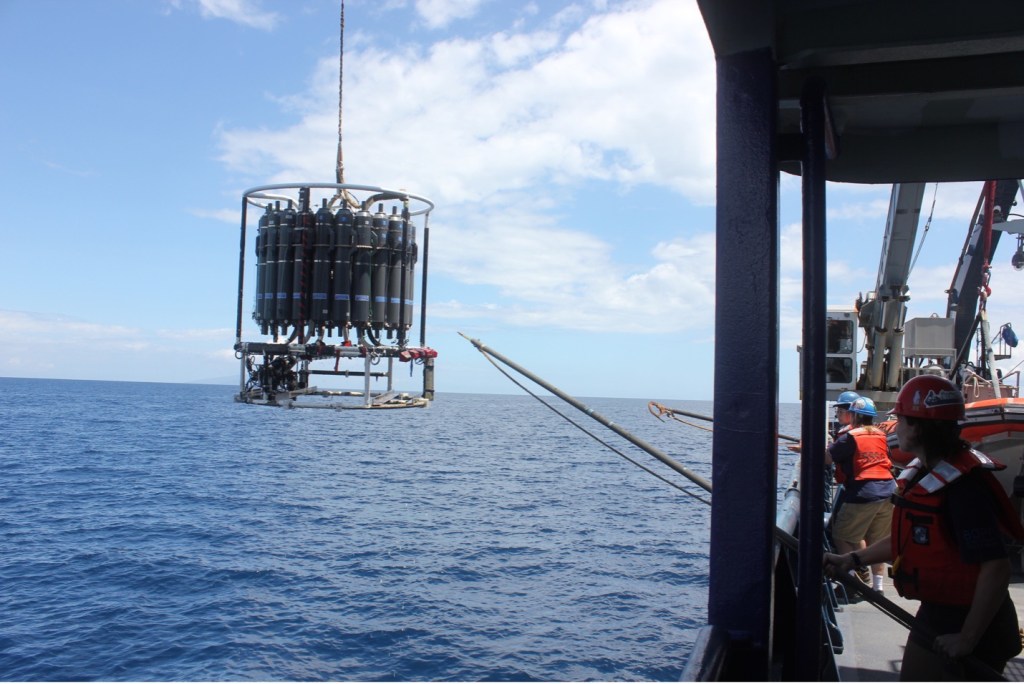
Dive time! Three people go in the submarine Alvin: the pilot and two scientists. Today, Nick is our driver, and Michelle and Darin are the scientists. They will be using their biological and geological expertise to collect images and samples to understand the deep-water biodiversity and geology of Galapagos. Alvin is in the water, and everyone gets ready to have an afternoon of preparation for when they are back on deck. But, operations at sea bring surprises sometimes. It was a short dive of ~1h, so Alvin is back much sooner than expected. Everyone mobilizes to bring some buckets filled with cold water to put the samples in. Meanwhile, another group (myself included) gets ready for water sampling. There is no time to waste, we get our hard hats and life jackets on and go to the deck to deploy the rosette and CTD. This equipment consists of sensors which measure properties of the seawater in real time such as temperature, salinity and dissolved oxygen. Also, it has 23 bottles which are used to collect seawater from different depths. The collected water will be analyzed later (in labs on land) to get information about seawater parameters such as nutrients, 14C, pH and alkalinity.

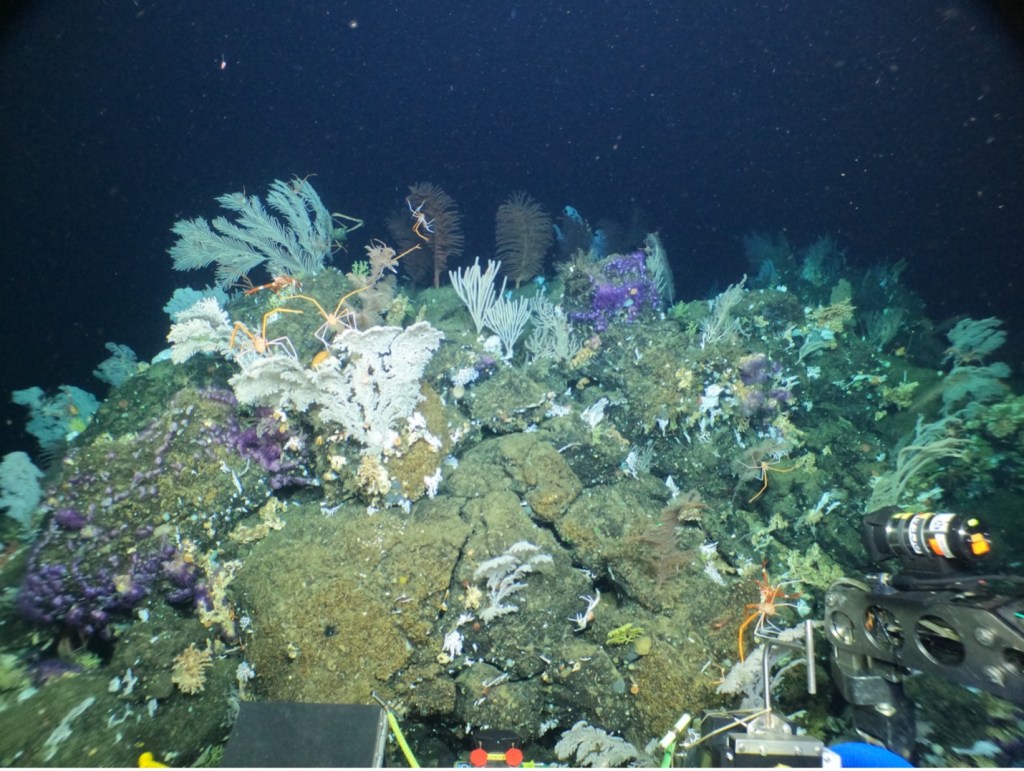
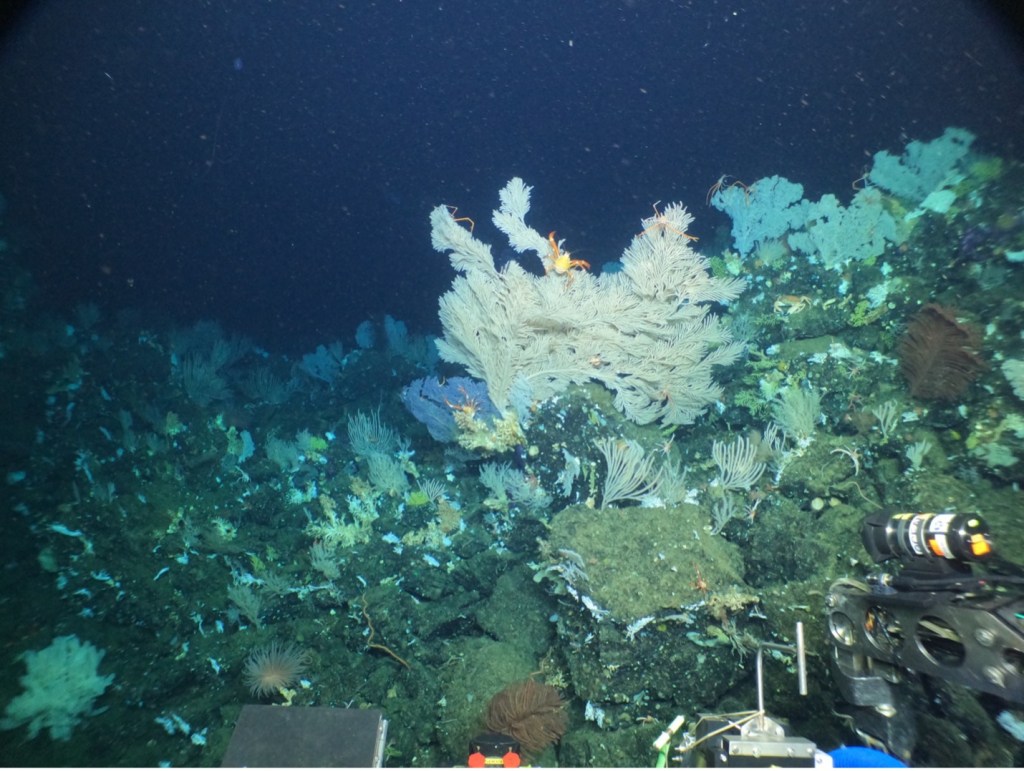
Another dip? While seawater sampling is happening, a decision is made: let’s go for another dive! Nick, Michelle and Darin are back in Alvin and to the sea bottom. The total time of this dive was 3h30, of which 2h30 was spent on the bottom. The scenery is beautiful, the rich biodiversity colors the background of dark rocks. These are volcanic rocks from ancient lava flows which solidify when they contact the cold seawater. The marine life observed includes corals, sea sponges, anemones, squat lobster, fishes… the list goes on. Once the samples are back on the ship, the next step is cataloging them, taking photos, and separating them amongst the working groups: rocks, biology and fossils. What a fantastic busy day! Now, back to the maps, discussions and planning the next dives!
Es el primer día de ciencia: ¿Cómo fue todo?
Por Malu de Carvalho Ferreira
Primer día de ciencia, ¡qué emocionante! Es un hermoso y cálido día con aguas tranquilas. Viejos volcanes en el fondo y rayos saltando fuera del agua. Pero la atención de todos está en otra parte: ¡el Alvin! Esta es la primera inmersión de la expedición y ha habido mucha preparación para ella. Los laboratorios (¡y los científicos!) están listos para recibir las muestras ( https://galapagosdeep2023.com/2023/03/26/getting-the-labs-ready-what-will-be-going-on-in-each- lab/ ), y el fondo marino ha sido cartografiado a lo largo de las últimas noches. Normalmente, el plan para una inmersión con Alvin se hace en base a mapas de la batimetría. Pero para esta inmersión, tuvimos acceso a imágenes y videos de expediciones anteriores, lo que nos ayudó a identificar sitios de muestreo y muestras específicos (https://www.gbif.org/es/grscicoll/institution/9a6b57bf-34e6-45fa-8fcd-64d237e9d767/metrics ).
tiempo de buceo! En el submarino Alvin van tres personas: el piloto y dos científicos. Hoy, Nick es nuestro conductor y Michelle y Darin son los científicos. Usarán su experiencia biológica y geológica para recopilar imágenes y muestras para comprender la biodiversidad y la geología de las aguas profundas de Galápagos. Alvin está en el agua y todos se preparan para pasar una tarde de preparación para cuando vuelvan a la cubierta. Pero, las operaciones en el mar a veces traen sorpresas. Fue una inmersión corta de aproximadamente 1 hora, por lo que Alvin regresó mucho antes de lo esperado. Todos se movilizan para traer unos baldes llenos de agua fría para colocar las muestras. Mientras tanto, otro grupo (entre los que me incluyo) se prepara para la toma de muestras de agua. No hay tiempo que perder, nos ponemos los cascos y los chalecos salvavidas y salimos a cubierta para desplegar el rosetón y el CTD. Este equipo consta de sensores que miden en tiempo real propiedades del agua de mar como temperatura, salinidad y oxígeno disuelto. Además, cuenta con 23 botellas que se utilizan para recolectar agua de mar de diferentes profundidades. El agua recolectada se analizará más tarde (en laboratorios en tierra) para obtener información sobre los parámetros del agua de mar, como nutrientes,14 C, pH y alcalinidad.
¿Otro chapuzón? Mientras se realiza el muestreo de agua de mar, se toma una decisión: ¡hagamos otra inmersión! Nick, Michelle y Darin están de vuelta en Alvin y en el fondo del mar. El tiempo total de esta inmersión fue de 3h30, de las cuales 2h30 fueron en el fondo. El paisaje es hermoso, la rica biodiversidad colorea el fondo de rocas oscuras. Estas son rocas volcánicas de antiguos flujos de lava que se solidifican cuando entran en contacto con el agua de mar fría. La vida marina observada incluye corales, esponjas marinas, anémonas, langostas rechonchas, peces… y la lista continúa. Una vez que las muestras están de regreso en el barco, el siguiente paso es catalogarlas, tomar fotografías y separarlas entre los grupos de trabajo: rocas, biología y fósiles. ¡Qué fantástico día ocupado! ¡Ahora, de vuelta a los mapas, discusiones y planificación de las próximas inmersiones!
 Galápagos Deep 2023 Expedition
Leave a comment