
By Samuel Mitchell
Desplácese hacia abajo para ver la publicación en español.
After several years of planning and a further couple of years of pandemic delays, a research expedition long in the making has finally arrived!
We are a team of scientists, explorers, observers, submersible technicians, and ship crew, on mission to map, image, and understand the seafloor of the Galápagos Platform like never before. Amongst the team of scientists are deep sea biologists, taxonomists, coral geochemists, marine geologists, volcanologists, isotope geochemists, petrologists, and oceanographers (just to name a few)… This is a highly multi-disciplinary team for a highly multi-disciplinary research expedition. You can find out more about our science objectives here!
On this website, we’ll be providing you all with daily updates and media to everything going on board the ship from: latest science goals, life on board a research vessel, to talking to the crew and Alvin submarine technicians. We want you all to learn about the incredible seafloor of the Galápagos, but also what being on a research expedition is like… from the very the beginning. So let’s start there!
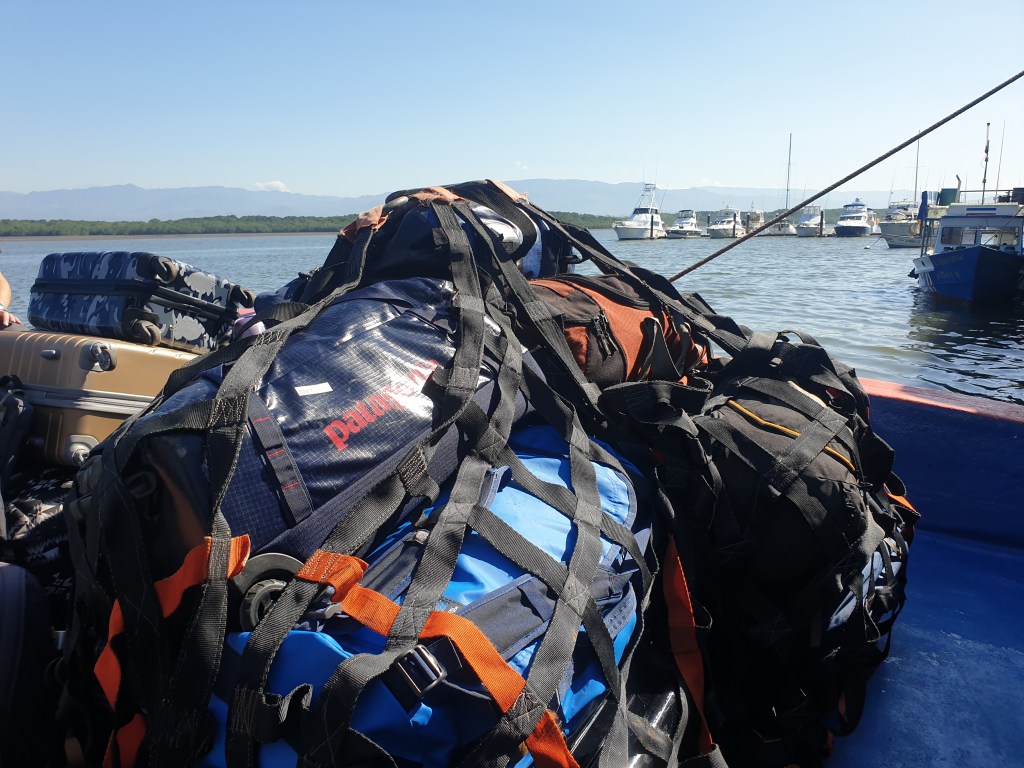
Assembling an array of scientists from across the world is no easy feat, but in a hotel in Santa Ana, Costa Rica, 18 scientists all met for the first time (in-person) as a research team – there were plenty of Zoom calls leading up to this point! After a day of initial meetings, icebreakers and last-minute supply runs, we took an on-land transfer from San José to the coastal town of Puntarenas where the R/V Atlantis was waiting for us… or was it? The vessel was actually waiting for us a “water taxi” ride away, so we loaded all of our bags and team on the taxi and set off across the water to go meet the Atlantis for the first time. To find out more about our vessel, head over to the Ship and sponsors page.

Once we arrived at the vessel, we were met by some of our crew, who helped us up the rope ladder onto the deck, where we were then led to our first orientation with our onboard science liaison officers – they will be critical to maintaining our upcoming science objectives and equipment. After orientation, a precautionary COVID-19 test, and being shown to our cabins, it was time for a first meal – our onboard chefs will be cooking up a storm for the next 5 weeks! Then it was finally time for a full tour of the ship.
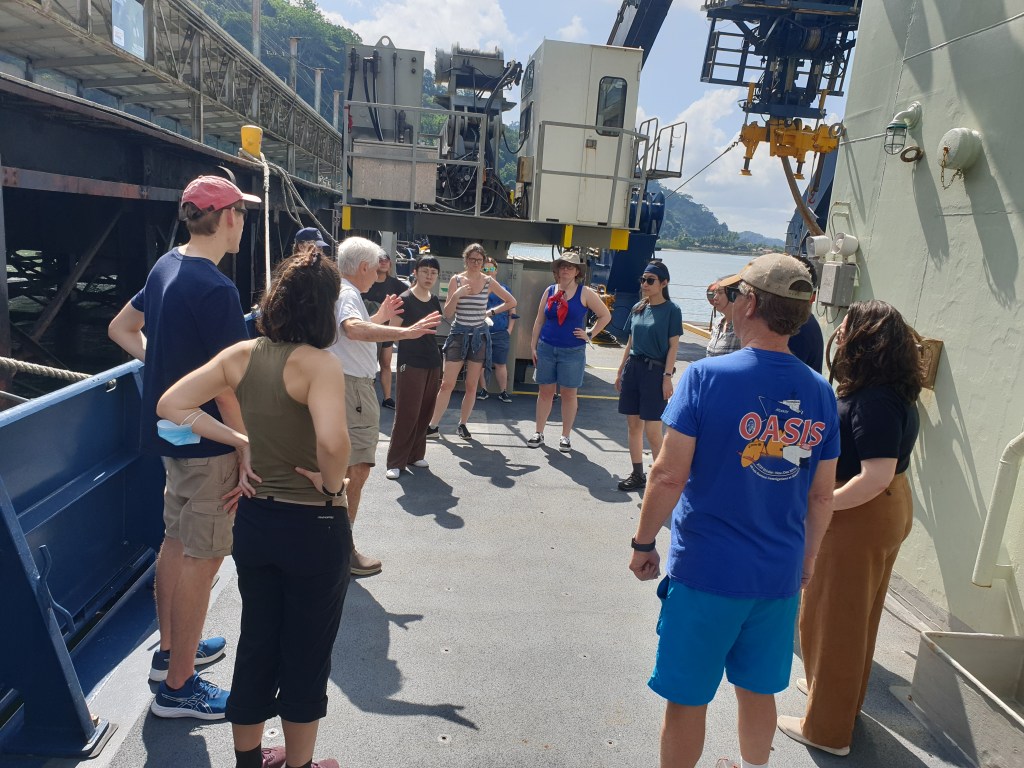
A first tour of any ship is always a little overwhelming (and no two vessels are the same of course, no matter HOW many expeditions you have been on – some of our more experienced members will attest to that!), but you force yourself to find out where all of the various routes, decks, passageways and ladders go. Main routes for us all to learn: cabin to the mess (meals!), cabin to the main lab (science!). After that, anything else is a bonus, but before long, you find your way around, and the ship becomes a temporary home.
So… time to set off for science?! Not quite… Because we are headed into the well-protected Galápagos National Park and Galápagos Marine Reserve for a month, the cleanliness of our ship is of vital importance to the ongoing conservation efforts of these incredibly ecologically important islands and its marine platform. Any invasive species brought into the islands by the vessel (by air or water) could be destructive and deadly to the endemic (locally unique) wildlife and ecosystems.
So, the vessel underwent a full fumigation and then spent a few days having the ENTIRE hull cleaned of barnacles and other attached marine life in the port of Golfito, Costa Rica. How? By a team of dedicated and hard-working divers! But where did that leave us as a science team? Well, we’ve had a very schedule of meetings, lab preparations (an upcoming post!), and visual “seafloor” training so that we all know what we’ll be looking at. Do the biologists know their rocks, and do the geologists know their coral species?? We will see…

But amongst that busy schedule, the science team did manage to spare a few hours to explore the local area of Golfito, and what a beautiful part of the country! We found our way to an incredible viewpoint, and along the way saw an array of amazing wildlife including macaws, a capybara, squirrel monkeys, an iguana, a sloth, a toucan, and great curassows! Quite a day for ticking off new species for most of the team.
The local exploring has now come to an end and we are almost ready to set off for the Galápagos! So stay tuned for future posts from the rest of our team, explore the rest of website, meet all of our science team, find out more about our vessel, and be ready for a thoroughly exciting research expedition!
¡BIENVENIDOS a Galápagos Deep Expedition 2023!
por Samuel Mitchell
Somos un equipo de científicos, exploradores, observadores, técnicos sumergibles y tripulantes de barcos, con la misión de cartografiar, obtener imágenes y comprender el fondo marino de la Plataforma de Galápagos como nunca antes. Entre el equipo de científicos se encuentran biólogos de aguas profundas, taxónomos, geoquímicos de corales, geólogos marinos, vulcanólogos, geoquímicos de isótopos, petrólogos y oceanógrafos (solo por nombrar algunos)… Este es un equipo altamente multidisciplinario para una investigación altamente multidisciplinaria. crucero. ¡ Puede encontrar más información sobre nuestros objetivos científicos aquí !
En este sitio web, les proporcionaremos actualizaciones diarias y medios de todo lo que sucede a bordo del barco, desde: los últimos objetivos científicos, la vida a bordo de un barco de investigación, hasta hablar con la tripulación y los técnicos del submarino Alvin . Queremos que todos aprendan sobre el increíble fondo marino de las Galápagos, pero también sobre cómo es estar en una expedición de investigación… desde el principio. ¡Así que empecemos por ahí!
Reunir una serie de científicos de todo el mundo no es tarea fácil, pero en un hotel en Santa Ana, Costa Rica, 18 científicos se reunieron por primera vez (en persona) como equipo de investigación; hubo muchas llamadas de Zoom que condujeron ¡hasta este punto! Después de un día de reuniones iniciales, rompehielos y recorridos de abastecimiento de última hora, tomamos un traslado terrestre desde San José hasta el pueblo costero de Puntarenas donde nos esperaba el R/V Atlantis … ¿o no? El barco nos estaba esperando en un “taxi acuático”, así que cargamos todas nuestras maletas y equipo en el taxi y partimos a través del agua para encontrarnos con el Atlantis por primera vez. Para obtener más información sobre nuestro barco, diríjase a la página Barco y patrocinadores .
Una vez que llegamos al barco, nos recibió parte de nuestra tripulación, que nos ayudó a subir la escalera de cuerda a la cubierta, donde luego nos llevaron a nuestra primera orientación con nuestros oficiales de enlace científico a bordo; serán fundamentales para mantener nuestro próximos objetivos y equipos científicos. Después de la orientación, una prueba preventiva de COVID-19 y de que nos mostraran nuestras cabinas, llegó el momento de una primera comida: ¡nuestros chefs a bordo cocinarán una tormenta durante las próximas 5 semanas! Entonces finalmente llegó el momento de un recorrido completo por el barco.
Un primer recorrido por cualquier barco siempre es un poco abrumador (y no hay dos barcos iguales, por supuesto, no importa en CUÁNTOS cruceros hayas estado, ¡algunos de nuestros miembros más experimentados lo atestiguan!), pero te obligas a ti mismo a averigüe adónde van todas las diversas rutas, cubiertas, pasillos y escaleras. Rutas principales para que todos aprendamos: cabina al comedor (¡comidas!), cabina al laboratorio principal (¡ciencia!). Después de eso, cualquier otra cosa es una ventaja, pero en poco tiempo, encuentras tu camino y el barco se convierte en un hogar temporal.
Entonces… ¿es hora de partir hacia la ciencia? No del todo… Debido a que nos dirigimos al Parque Nacional Galápagos y la Reserva Marina de Galápagos bien protegidos durante un mes, la limpieza de nuestro barco es de vital importancia para los esfuerzos continuos de conservación de estas islas increíblemente importantes desde el punto de vista ecológico y su plataforma marina. Cualquier especie invasora traída a las islas por la embarcación (por aire o agua) podría ser destructiva y mortal para la vida silvestre y los ecosistemas endémicos (localmente únicos).
Entonces, la embarcación se sometió a una fumigación completa y luego pasó unos días limpiando TODO el casco de percebes y otra vida marina adherida en el puerto de Golfito, Costa Rica. ¿Cómo? ¡Por un equipo de buzos dedicados y trabajadores! Pero, ¿dónde nos dejó eso como equipo científico? Bueno, hemos tenido un programa muy completo de reuniones, preparaciones de laboratorio (¡una próxima publicación!) y capacitación visual del “fondo marino” para que todos sepamos lo que estaremos viendo. ¿Los biólogos conocen sus rocas y los geólogos conocen sus especies de coral? Veremos…
Pero entre esa apretada agenda, el equipo científico se las arregló para dedicar algunas horas a explorar el área local de Golfito, ¡y qué hermosa parte del país! ¡Encontramos nuestro camino a un punto de vista increíble, y en el camino vimos una variedad de vida salvaje increíble que incluía guacamayos, capibaras, monos ardilla, una iguana, un perezoso, un tucán y grandes paujiles! Todo un día para marcar nuevas especies para la mayoría del equipo.
¡La exploración local ha llegado a su fin y estamos casi listos para partir hacia las Galápagos! ¡Así que permanezca atento a futuras publicaciones del resto de nuestro equipo, explore el resto del sitio web, conozca a todo nuestro equipo científico, descubra más sobre nuestro barco y prepárese para una expedición de investigación completamente emocionante!
 Galápagos Deep 2023 Expedition
Leave a comment