
By Maoyu Wang
Desplácese hacia abajo para ver la publicación en español.
Atlantis is a wonderful scientific research ship with perfect lab systems. Preparation is the key to give full play to the performance of the laboratory. So, for the first few days, we focused on getting familiar with the labs and getting the labs ready.
Safety is the most important thing on the sea. The hull will shake slightly but unavoidably during the course of the ship, so we must fix everything if we don’t want anyone to get hit by equipment. Some big and heavy things were placed under the tables or some corners and secured by ratchet straps or bungee ropes. The small things that are often used were placed on the table, and mats were placed underneath to increase friction so that they would not fall down during cruise. Of course, we labeled everything by tapes so that we would not waste time to find things when we need them urgently.
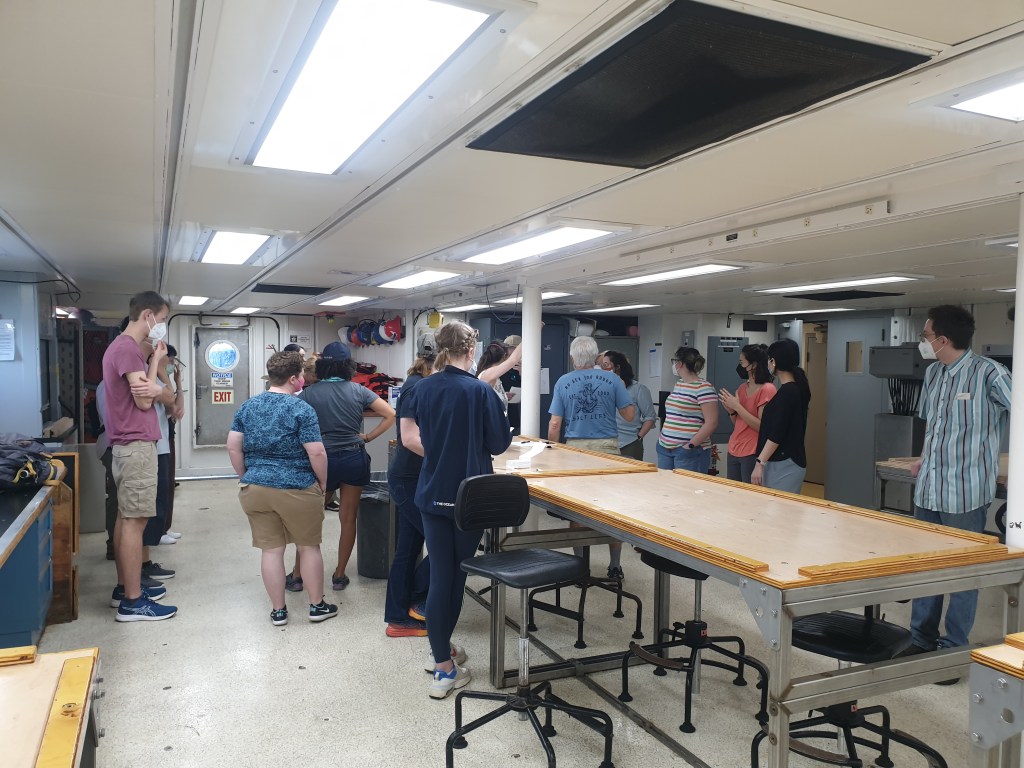
The previous lab users left us a very clean environment (Thanks a lot to them!). However, as we hope to carry out some very tricky low-concentration nuclides analysis (for example, radiocarbon), a thorough cleaning process is a must. We chose 10% Decon90 as the detergent after we tested it did not hurt any facility. Then we wiped all the table surfaces, walls and doors (especially the door handles) to avoid any potential contamination. We also put a layer of plastic film on the table before we put anything on them. Everything we did is to make the lab as clean as possible.
We will use four labs mostly: the main lab, hydro lab, wet lab and rock preparation lab. Main lab is the biggest one. The pre-processing work of the collected corals will be carried out here. There is a fume hood at the lab entrance and you can find something familiar to geochemists here (i.e. pipette, Milli-Q carboy, graduated cylinder and so on). A coral bleaching site is just nearby the fume hood with some bleaching solution containers. On the table in the middle of the lab, we put many different size trays for coral drying. Some fans were creatively hung above the trays to aid in the drying of the corals (cover photo). The balances and cameras were available on the tables nearby so that we can weigh and photograph coral samples conveniently. Some public computers and office areas are located at the end of main lab, so that we can check the data and make records in time.
Hydro lab will be a place to process seawater and very interesting eDNA samples. This lab stores all the clean seawater bottles for different purposes (i.e. CO3, radiocarbon, carbon isotope, oxygen isotope, silicate isotope and nutrients). We fixed our pumps here to filter water sample as soon as we get the CTD samples. There are also some interesting equipment for eDNA analysis… but we will take more about that in a later post! The Alvin engineers will share this lab with us, so you will have opportunities to watch their cool work if you spend a lot of time in hydro lab.

Wet lab is the coldest lab among the four labs as we will process our sediment samples here. We have cleaned all the sediment cores (including push cores and muticores) here by Decon90 and Milli-Q water. A rock saw is also located in the corner of the lab for cutting cores and rock samples in the future (Don’t worry, it is very safe).
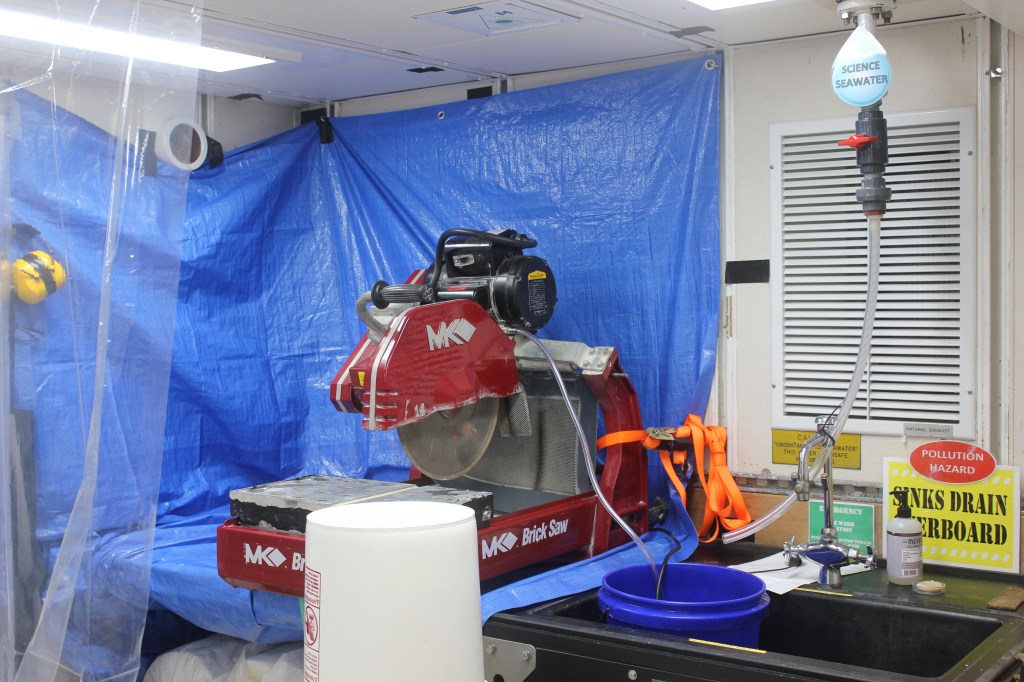
Rock preparation lab is the “rock club” in the ship. If you want find our geologists, rock preparation lab is the best choice. The table in the middle of rock preparation lab is covered with plastic films, it will be used for the identification and classification of rock samples before we store them. We also set a photo site for nice rock pictures and a heating lamp to dry down the wet basalt samples.

Thanks to everybody’s excellent work, all the labs are ready to use now. Hopefully we will have an enjoyable time and collect some interesting samples in this cruise!
Preparando los laboratorios: ¿Qué sucederá en cada laboratorio?
por Maoyu Wang
Atlantis es un maravilloso barco de investigación científica con sistemas de laboratorio perfectos. La preparación es la clave para dar rienda suelta al rendimiento del laboratorio. Entonces, durante los primeros días, nos enfocamos en familiarizarnos con los laboratorios y prepararlos.
La seguridad es lo más importante en el mar. El casco temblará leve pero inevitablemente durante el transcurso de la nave, por lo que debemos arreglarlo todo si no queremos que nadie resulte golpeado por el equipo. Algunas cosas grandes y pesadas se colocaron debajo de las mesas o en algunas esquinas y se aseguraron con correas de trinquete o cuerdas elásticas. Las cosas pequeñas que se usan a menudo se colocaron sobre la mesa y se colocaron tapetes debajo para aumentar la fricción para que no se caigan durante el crucero. Por supuesto, etiquetamos todo con cintas para que no perdamos tiempo buscando cosas cuando las necesitamos con urgencia.
Los usuarios anteriores del laboratorio nos dejaron un ambiente muy limpio (¡Muchas gracias a ellos!). Sin embargo, como esperamos llevar a cabo algunos análisis de nucleidos de baja concentración muy complicados (por ejemplo, radiocarbono), es imprescindible un proceso de limpieza a fondo. Elegimos 10% Decon90 como detergente después de probar que no dañaba ninguna instalación. Luego limpiamos todas las superficies de las mesas, paredes y puertas (especialmente las manijas de las puertas) para evitar cualquier posible contaminación. También ponemos una capa de film plástico sobre la mesa antes de ponerles nada encima. Todo lo que hicimos fue para que el laboratorio estuviera lo más limpio posible.
Utilizaremos principalmente cuatro laboratorios: el laboratorio principal, el laboratorio hidroeléctrico, el laboratorio húmedo y el laboratorio de preparación de rocas. El laboratorio principal es el más grande. Aquí se realizará el trabajo de preprocesamiento de los corales recolectados. Hay una campana extractora en la entrada del laboratorio y aquí puede encontrar algo familiar para los geoquímicos (es decir, una pipeta, una bombona Milli-Q, un cilindro graduado, etc.). Un sitio de blanqueamiento de coral está cerca de la campana extractora con algunos contenedores de solución blanqueadora. Sobre la mesa en el centro del laboratorio, colocamos muchas bandejas de diferentes tamaños para el secado del coral. Se colgaron creativamente algunos abanicos sobre las bandejas para ayudar en el secado de los corales. Las balanzas y las cámaras estaban disponibles en las mesas cercanas para que pudiéramos pesar y fotografiar muestras de coral convenientemente. Algunas computadoras públicas y áreas de oficina están ubicadas al final del laboratorio principal,
Hydro lab será un lugar para procesar agua de mar y muestras de eDNA muy interesantes. Este laboratorio almacena todas las botellas de agua de mar limpia para diferentes propósitos (es decir, CO 3 , radiocarbono, isótopo de carbono, isótopo de oxígeno, isótopo de silicato y nutrientes). Arreglamos nuestras bombas aquí para filtrar muestras de agua tan pronto como recibimos las muestras de CTD. También hay algunos equipos interesantes para el análisis de eDNA… ¡pero hablaremos más sobre eso en una publicación posterior! Los ingenieros de Alvin compartirán este laboratorio con nosotros, por lo que tendrá la oportunidad de ver su excelente trabajo si pasa mucho tiempo en el laboratorio hidroeléctrico.
El laboratorio húmedo es el laboratorio más frío entre los cuatro laboratorios, ya que aquí procesaremos nuestras muestras de sedimentos. Hemos limpiado todos los núcleos de sedimentos (incluidos los núcleos de empuje y muticores) aquí con agua Decon90 y Milli-Q. También se encuentra una sierra para rocas en la esquina del laboratorio para cortar núcleos y muestras de rocas en el futuro (no se preocupe, es muy seguro).
El laboratorio de preparación de rocas es el “club de rocas” del barco. Si desea encontrar a nuestros geólogos, el laboratorio de preparación de rocas es la mejor opción. La mesa en el medio del laboratorio de preparación de rocas está cubierta con películas plásticas, se usará para la identificación y clasificación de muestras de rocas antes de que las almacenemos. También establecimos un sitio de fotos para bonitas fotografías de rocas y una lámpara de calefacción para secar las muestras húmedas de basalto. Gracias al excelente trabajo de todos, todos los laboratorios están listos para usar ahora. ¡Ojalá pasemos un rato agradable y recolectemos algunas muestras interesantes en este crucero!

 Galápagos Deep 2023 Expedition
Leave a comment